
What is a hotel PMS? The property management system, explained
A PMS (property management system) is the operating system of a hotel: it manages reservations, room assignments, check-ins and check-outs, guest folios, housekeeping and reporting. Modern cloud PMS also connect to channel managers, booking engines and payment systems. If a hotel runs on one system, it's this one.
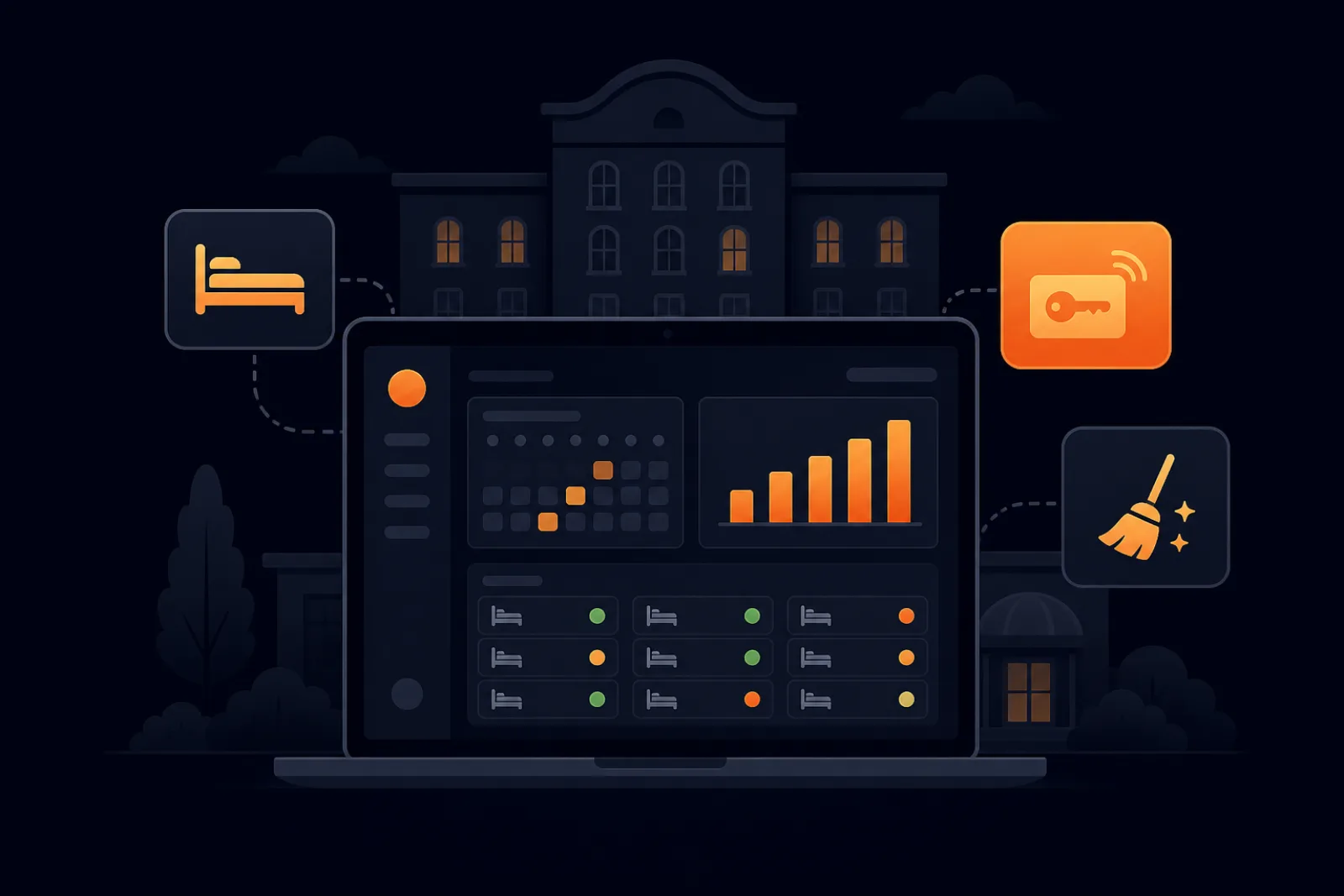
What a PMS actually does
The core: a reservations calendar (who sleeps where, when), guest profiles and folios (charges, payments, invoices), front-desk operations (check-in/out, room moves), housekeeping boards (clean/dirty/inspected) and reports (occupancy, ADR, RevPAR). Around that core, modern systems add rate management, payment processing and connectivity to distribution channels.
A useful mental model: the PMS holds the truth of the hotel, and every module is a view of that truth for a different team.
- Front desk sees today's arrivals, departures and in-house guests.
- Housekeeping sees the same rooms as a clean/dirty/inspected board.
- Revenue sees them as rates, restrictions and pickup.
- Accounting sees folios, payments, taxes and invoices.
- Management sees occupancy, ADR and RevPAR trends.
That's why choosing a PMS is an operational decision, not an IT one: every team touches it daily.
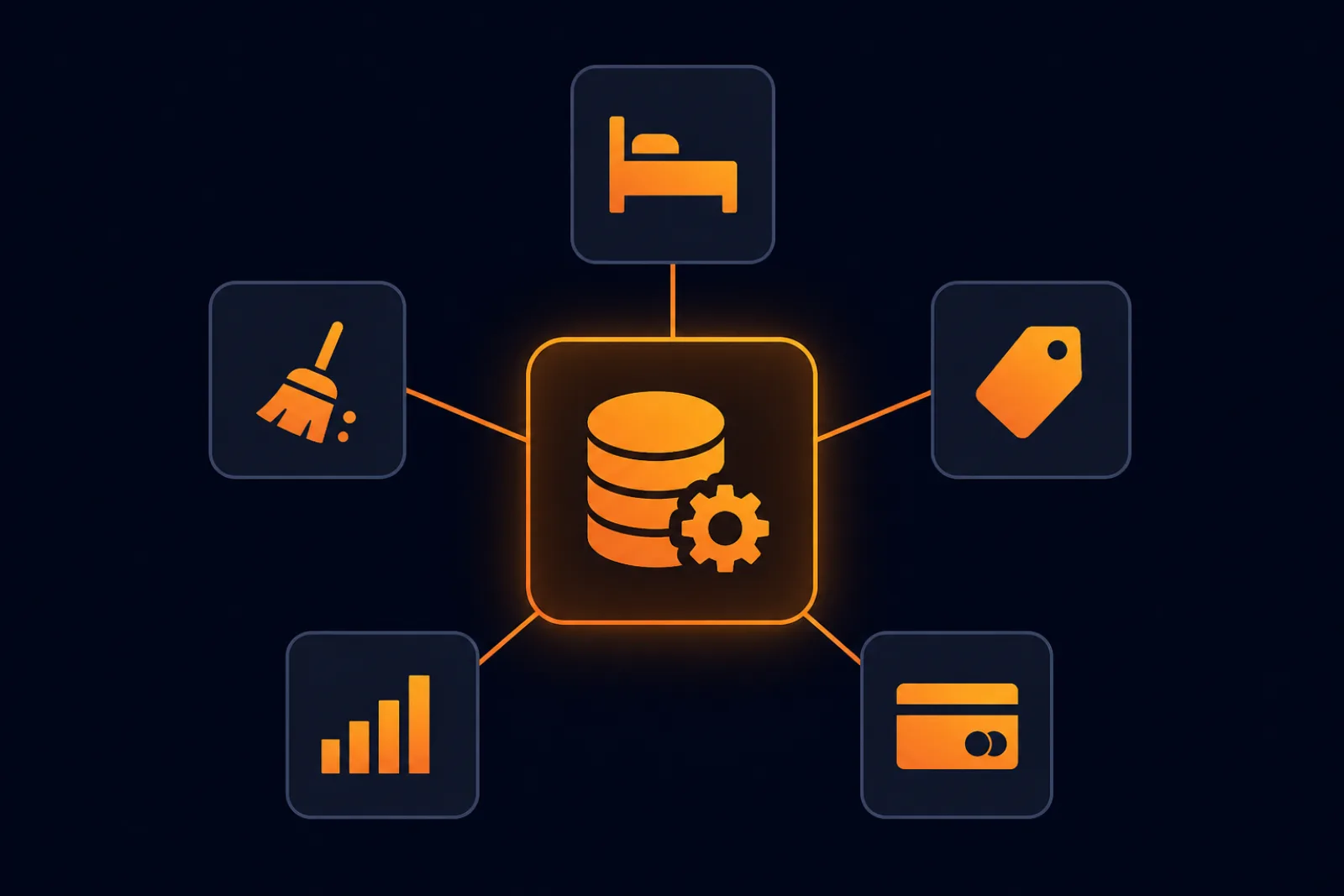
Cloud PMS vs legacy (on-premise) PMS
Legacy systems live on a server at the hotel: powerful but expensive to maintain, hard to integrate and tied to a desk. Cloud PMS (Cloudbeds, Mews, apaleo, RoomRaccoon and dozens more) run in the browser, update themselves, connect via APIs and price by subscription. For independent hotels the cloud won: lower cost, faster onboarding and an ecosystem of connectable tools.
| Cloud PMS | Legacy / on-premise | |
|---|---|---|
| Access | Any browser, any device | Installed terminals at the property |
| Cost model | Monthly subscription per room/property | License + servers + maintenance contracts |
| Updates | Continuous, automatic | Versioned upgrades, often paid |
| Integrations | Open APIs, marketplace of connectable tools | Custom interfaces, per-integration fees |
| Typical fit | Independent hotels, small groups | Large chains with legacy infrastructure |
How to choose a PMS
Match it to your operation, not to a feature list: number of rooms and properties, front-desk workflow, the integrations you actually need (channel manager, booking engine, payments, door locks), local invoicing/tax requirements, and total cost including onboarding. Ask for a sandbox and run a week of real scenarios — check-in, room move, split folio, refund — before signing.
Questions that surface the real differences in a demo:
- How long does a full check-in take, in clicks?
- Does channel management come built in, or do I pay for a separate layer?
- Which booking engines and payment providers are certified integrations?
- Does it handle my country's invoicing and tax rules natively?
- What does onboarding cost, and how long until the team operates without support?
- If I leave, how do I export my reservations and guest history?
The PMS and your direct channel
A PMS manages your hotel; it doesn't win you direct bookings. That's the job of your website and booking engine — and the key is that they read the same live availability your PMS holds. GuruHotel keeps your PMS as the source of truth (direct integration with Cloudbeds, 345+ PMS via Channex) and puts an AI-built, conversion-optimized website with Stripe checkout on top, so the direct channel grows without touching your operation.
How GuruHotel helps
GuruHotel turns a hotel's official website into a direct booking channel: an AI-built site, a conversion-optimized booking engine, real-time inventory synced with your PMS (Cloudbeds direct, 345+ more via Channex) and Stripe-powered payments — commission-free on every direct reservation.
FAQ
What does PMS stand for in hotels?
Property Management System — the software that manages a hotel's reservations, rooms, guest folios, housekeeping and reporting. It's the central system of record most other hotel tech connects to.
How much does a hotel PMS cost?
Cloud PMS for independent hotels typically price per room per month — small properties often land between $100 and $300 monthly all-in, while feature-heavy plans or larger inventories go higher. Watch the extras: onboarding fees, payment processing margins and paid integrations often matter more than the sticker price.
What's the difference between a PMS and a CRS?
The PMS runs one property's operation (rooms, folios, housekeeping). A CRS — central reservation system — sits above properties and centralizes reservations and rates across a chain or group, distributing them to channels. Independent hotels usually don't need a separate CRS; the PMS plus a channel manager covers the same ground.
How does GuruHotel relate to this?
GuruHotel provides an AI-built hotel website, a direct booking engine, real-time inventory and Stripe-powered payments, helping independent hotels grow commission-free direct bookings alongside their OTA channels.