
What is an OTA? Online travel agencies explained for hotels
An OTA (online travel agency) is a website or app where travelers search, compare and book travel — hotels, flights, cars — from many suppliers in one place. Booking.com, Expedia and Airbnb are the giants. For hotels, OTAs are a demand channel that charges a 15–25% commission per reservation, which is why most properties pair them with a commission-free direct channel.
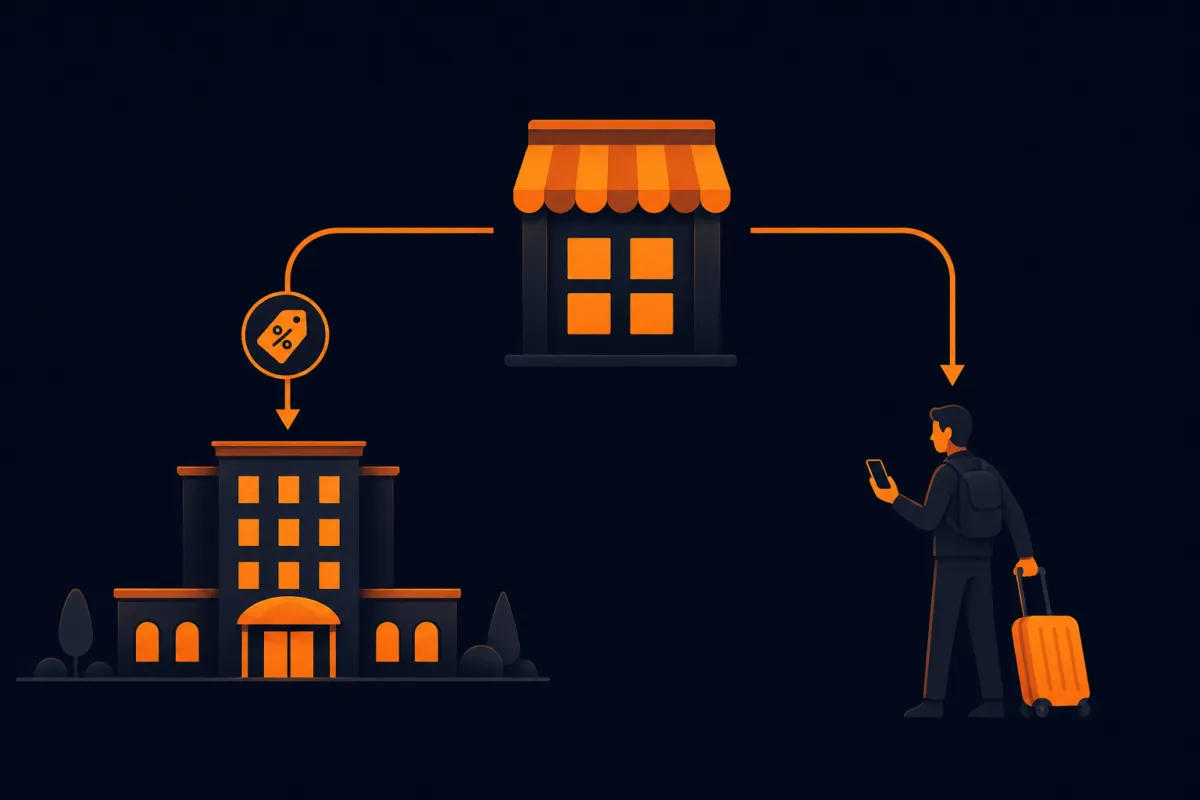
How OTAs work
An OTA aggregates inventory from thousands of suppliers and sells it under its own brand. The hotel loads rooms, rates and availability (directly in the OTA's extranet or automatically through a channel manager); the OTA markets them to its audience and takes a commission when a stay is completed. Two business models coexist: the merchant model, where the OTA collects the guest's payment and remits the hotel later, and the agency model, where the guest pays the hotel directly and the OTA invoices its commission afterward.
The major OTAs (and who owns whom)
The market looks crowded but consolidates into a few groups. Knowing the family tree matters: connecting to one group often distributes you across several brands at once.
| Group | Main brands | Strongest in |
|---|---|---|
| Booking Holdings | Booking.com, Priceline, Agoda, Kayak | Europe, Latin America, Asia (Agoda) |
| Expedia Group | Expedia, Hotels.com, Vrbo, Orbitz, Travelocity | North America, packages |
| Airbnb | Airbnb | Alternative stays, long stays |
| Trip.com Group | Trip.com, Ctrip, Skyscanner | Asia-Pacific, Chinese outbound |
| Despegar | Despegar, Decolar, Best Day | Latin America |
What OTAs cost a hotel
Standard commissions run 15–25% per completed reservation, before optional visibility programs (Genius, Preferred Partner, deals) that trade additional margin for ranking. On a $120/night stay of three nights, an 18% commission is about $65 — per booking. Multiply by a year of OTA-heavy distribution and commissions often become a hotel's largest marketing expense, which is rarely read as such because it's deducted before the money arrives.
Are OTAs good or bad for hotels?
Both, depending on how you use them. OTAs deliver reach no independent hotel can buy alone: global audiences, translated listings, wallet-ready checkout and the 'billboard effect' (guests discover you on an OTA, then search your name). The risks are dependency and margin erosion — if 80–90% of your bookings arrive with a 15–25% tax and the OTA owns the guest relationship and their email, your business is renting its demand. Treat OTAs as acquisition, not as your whole distribution.
The healthy mix: OTAs plus a direct channel
The playbook mature hotels run: stay visible on the 2–3 OTAs that matter in your market, keep rates and availability synced automatically via a channel manager, and convert the billboard effect on your own website — a fast site with a real booking engine, best-rate messaging and perks OTAs can't offer (flexible policies, upgrades, direct communication). Every guest moved from OTA to direct on a future stay is 15–25% of revenue recovered.
How GuruHotel helps
GuruHotel turns a hotel's official website into a direct booking channel: an AI-built site, a conversion-optimized booking engine, real-time inventory synced with your PMS (Cloudbeds direct, 345+ more via Channex) and Stripe-powered payments — commission-free on every direct reservation.
FAQ
What does OTA stand for?
OTA stands for Online Travel Agency: a digital marketplace (like Booking.com, Expedia or Airbnb) where travelers book hotels, flights or experiences from many suppliers. The OTA earns a commission from the supplier on each completed booking.
What is the difference between an OTA and a metasearch engine?
An OTA sells the reservation on its own site and processes the transaction. A metasearch engine (Google Hotels, Trivago, Kayak) only compares prices and sends the traveler to book elsewhere — on an OTA or on the hotel's own website. Metasearch is where a well-priced direct channel can win the booking back.
How do I list my hotel on an OTA?
Register on the OTA's partner portal (join.booking.com, Expedia Partner Central, etc.), load property details, photos, policies and rates, and go live after verification. From day one, connect the OTA to a channel manager synced with your PMS so availability updates automatically and overbookings don't happen.
How does GuruHotel relate to this?
GuruHotel provides an AI-built hotel website, a direct booking engine, real-time inventory and Stripe-powered payments, helping independent hotels grow commission-free direct bookings alongside their OTA channels.